Saturday, June 29, 2013


                        Idling on La Grand Jatte

Georges Seurat's pointillist masterpiece...A Sunday on La Grande Jatte (1884-86) feels like a Fourth of July painting in its expression 
of communal relaxation and enjoyment...almost a complete suspension of motion and purposeful activity.

Seurat was experimenting with a new technique based on modern scientific color theories that would "mix the colors" in the viewer's eye rather than on his palette.He depicts literally dozens of Parisians and their dogs, and even one fashionably dressed woman with her Capuchin monkey on a leash.Some have suggested the monkey was symbolic of licentiousness...and the woman was,in fact, a prostitute.In any case, Seurat gives us multiple figures,mostly in profile,from various classes,genders,ages and presumably "occupations" on a day of rest.

There are,speculatively, several prostitutes,who were frequent visitors on La Grand Jatte looking for male customers,in Seurat's painting...most strikingly,and rather oddly,the woman fishing on the bank of the Seine...presumably "fishing" for a customer among the various and sundry men gathered along the bank of the Seine.

Influenced by ancient Egyptian art which he sketched in the Louvre, Seurat uses mainly profiles of figures to create a sense of motionless disengagement...strangely...no one seems to be talking or interacting with one another...they are,as it were,"frozen" in time and ennui...one young girl in the center of the painting is contemplating a small bouquet of flowers,while to the left of her is a bizarre  tableau of a hulking oarsman in a sleeveless shirt smoking a pipe surrounded by a  properly attired woman working on needlework,and a dandy in a top hat with a spindly-looking walking stick.

Overall, La Grand Jatte is in suspended animation...a very static, frozen moment in time...but, in contrast to this feeling of suspension, is Seurat's minor-key counterpoint of time moving on and exuberant motion in the figure of the little running girl in the background, and the small running dog in the foreground of the painting.Moreover,to create a sense of fresh reawakening...Seurat painted in six delicate, fluttering butterflies.

And his artistic "sidebar" in La Grande Jatte is, of course, the river Seine itself.Like the social milieu on the bank of river,the river reflects the changing modernist Parisian society.There are not only the pastimes of the wealthy...rowing and sailboating...on the river,but also the encroaching modern world of the steamboat.And since Seurat depicts a Sunday on La Grande Jatte,the steamboats going up and down the Seine were most likely the sights-seeing steamers or Bateau Mouche which were a great success.

To enhance the sense of a moment frozen in time on La Grande Jatte...Seurat,quite unusally, painted his own pointillist "freeze frame" around his painting to heighten its chromatic effectiveness.The painting was then conventionally framed in a simple white wooden frame for exhibition in the last Impressionist exhibition of 1886.That's also how the painting is exhibited today at The Art Institute of Chicago. 

All in all... La Grand Jatte is not only a beautiful depiction of a carefree summer day  or holiday...but also a highly individualistic and unique contribution to the oeuvre of the late 19th century in Paris.Seurat remarked that "I painted like that because I wanted to get through to something new - a kind of painting that was my own"...although only 29,with only two more years to live,Seurat succeeded so beautifully with his La Grande Jatte.


Friday, April 26, 2013


           Edward Hopper At the Movies
            [Scenes Without Scenarios]


Edward Hopper...perhaps twentieth-century America's most uniquely urban and desolate realist...wasn't a sociable man...even his wife, Jo, said so. She said when she
tried to introduce "Eddie" to her friends,
he just wouldn't "make nice", and he simply had no interest in meeting and interacting with "new" people.


Edward's real passions in life were painting and reading(especially Ralph Waldo Emerson)...two of the most "unsociable" activities known to humankind. As Hopper's much younger fellow-realist artist, Andrew Wyeth, remarked..."I would never let anybody watch me painting...it would be like somebody watching you have sex - painting is that personal to me".Painting was that "personal" to Edward Hopper,too.And he took painting... this most unsociable of personal engagements...very seriously throughout his entire artistic oeuvre.
He also told those who persistently asked (like art critics and reviewers) that everything there was to know about him was in his paintings..."The whole answer is there on the canvas".Once even when he was asked by an interviewer what he was after in one of his starkest paintings,he simply answered,"I'm after me".


However, Hopper did give us one simply
written "Statement" about his approach to his painting in 1953 when he submitted a "handwritten note" to the journal, Reality. His remarks provide telling insight into his artistic "modus operandi":

             Great art is the outward 
             expression of an inner life
             in the artist, and this inner
             life will result in his personal
             vision of the world. No amount
             of skillful invention can replace
             the essential element of 
             imagination. One of the weak-
             nesses of much abstract 
             painting is the attempt to 
             substitute the inventions of
             the human intellect for a 
             private imaginative conception.

              The inner life of a human
              being is a vast and varied
              realm and does not concern
              itself alone with stimulating
              arrangements of color, form
              and design.

Even earlier in 1939, Hopper revealed
a deeper "way into"much of his highly personal,  individualized,and characteristically "unsociable" paintings..."So much of 
every art is an expression of the subconscious that it seems to me most of all the important qualities are put there unconsciously, and little of importance by the conscious intellect". 


As unsociable and "uncommunicative"
to strangers as Edward Hopper was throughout his life, he also loved going to "the movies". He once said:"When I don't feel in the mood for painting, I go to the movies for a week or more. I go on a regular movie binge!"Hopper, we can imagine, was "a solitary figure" in the movie theater... just "looking"...probably without any social interaction with "the others" in the theater.


An early grisaille painting of Hopper's done when he was in his early twenties and evolving his painting style and thematics..."Solitary Figure in a Theatre",c.1903...already captures much of Hopper's later cinematic painting scenes of lone figures "looking"...looking in and looking out...reading,engaged in inner ruminations,looking out windows in hotel rooms,offices and trains...all existentially isolated in their own introspection, and engaged in "transcendental silence". 


Edward Hopper,Solitary Figure in a Theatre,c.1902-4,oil on board,Whitney Museum of American Art,New York


This smallish monochromatic oil painting "on board" may just be Hopper's first visual "meditation" on the engrossing introspective silence of the early "black and white" silent movies of the time...the first full-length movie with integrated sound did not appear until 1927.Also,as Antonia Lant notes in her essay,"The Film Crowd",Moving Pictures American Art and Early Film 1880-1910,Hopper as an artist was undoubtedly "drawn to the dawn of cinema for its intrigue of a new sensory culture".
Later in the 1930s,Hopper became fascinated with "film noir",and he was influenced by its cinematography and the most essential aspect of filmmaking..."the frame".In addition to "framing",his paintings and cinematic approach to them,share many formal dimensions with film noir such as lighting,the play of light and shadow,color saturation,tonal texture,scale,angles of view and vision and...preeminently...the human form and figure.


Edward Hopper,The Balcony,or The Movies,1928 (Drypoint etching,13x17 inches)Whitney Museum of American Art,New York


Diane Arbus,photograph,In The Balcony Empire Theater,42nd Street,New York City, 1958

It is revealing to contrast Edward Hopper's early "film noir" focus in his etching,The Balcony, on the introspective woman on the right with her hand on the side of her face,and on the nuanced play of light and shadow,especially on the light coming from the three-pronged light sconce across from this woman,and on the "high-angle,mildly vertiginous" perspective from the uppermost gallery ... with the much later photographer Diane Arbus's In The Balcony Empire Theater,42nd Street,New York City, 1958.Arbus's Balcony photograph creates an entirely different "communal" focus,with a very different lighting,angle of vision and sense of the goings-on of the"hoi polloi"...of the activity of "the boys" in the balcony.

Already in Hopper's 1928 drypoint,The Balcony,rather than a sense of the crowd's "energy and activity" in the movie theater,Hopper  again captures a solitary individual in a "brooding and silent interior" which conveys a "sense of being sealed off from the outside world".All of Hopper's interior movie theaters are "hushed realms...closer to museums or libraries" than to places filled with speech,music and sounds.

An artist contemporary with Hopper,and who Hopper admired, and even wrote about,and who also studied with Hopper's greatly admired painting teacher,Robert Henri... was John French Sloan.Robert Henri and John Sloan were both major figures among the so-called Ashcan school of realist artists.And Sloan,like Hopper,both of whom Henri advised as students at the New York School of Art, to "go to the theater",was drawn to the early silent "black and white" movies. But Sloan depicted in his 1907 oil painting,Movies,Five Cents, a markedly different movie theater "interior" from those characteristically "suspended moments" captured in Hopper's "silent theatrum mundi" paintings.


   John Sloan,Movies,Five Cents, 
                 oil on canvas,1907
              
In Sloan's painting,Movies,Five Cents, we see a "new urban phenomenon" and space...the cheap nickelodeon, or as one writer called it, "the nickel dump".
Sloan's emphasis in his movie theater painting is on the "unruly miscellany" of the audience in a cheap Greenwich Village venue...a democratic,integrated,diverse audience of moviegoers consisting of a range of classes,genders and races.

Sloan's movie theater is a small,crowded,warm,physically intimate communal "site of sociality", and of implicit eroticism and titilating sexuality...both on,and off,the movie screen.It is a place of shared pleasurable experience,and shared escape into the romantic idyll on the movie screen.

Sloan focuses on the individual activity and responses of the audience members...in the lower half of the painting we see a man slumped over asleep,possibly intoxicated, next to him is a young black woman in a funky hat clasping her chest as if experiencing a cinematic frisson brought on by the  bench kissing scene on the movie screen,in front of them are two women in elegant hats...one immersed in the black-and-white kissing scene, the other turned away from the screen,perhaps looking in amusement at the slumped over man behind her,or at us...the viewers of the painting,a man and another  woman wearing an extravagantly plumed hat enter the theater on the right side of the painting "in media res" to be seated...in the early days of silent movies,moviegoers could enter into the movie theater at any time during the movie...hence the origin of the expression,"this is where I came in"!

Sloan's painting is a humorous,almost Hogarthian satirical depiction of the "human comedy" in all its faux finery and gaudy splendor, enjoying "cheap thrills" in the dark.His painting,Movies, Five Cents, is a far cry from the "suspended introspective" movie theater interior found in Edward Hopper's greatest movie theater painting,New York Movie.

Leading up to Hopper's 1939 "magnum opus" movie theater painting,New York Movie, were his two other impressive movie theater paintings:The Circle Theatre completed in 1936, and The Sheridan Theatre completed in 1937.


Edward Hopper,The Circle Theatre,                                                                                                    
     oil on canvas,27x36 in.,1936


Hopper's 1936 exterior painting of The Circle Theatre is almost like a sharper,less fluid 1960s Richard Diebenkorn abstracted architectural "cityscape"...while the "theater is the nominal subject of the painting and its central presence,...it is incorporated into an ensemble of forms" and muted colors punctuated by the bright red stop light on the lower right side of the painting.


Richard Diebenkorn,Cityscape I,1963,
                oil on canvas
                             
As so often in Hopper's paintings,we are as observers of the painting...looking and seeing,but ultimately our vision is frustrated.In  The Circle Theatre,our vision into the theatre entrance is "blocked" by a solid black subway kiosk,and the dark lobby doors suggest that the theater is not open for business.Hopper has chosen a subject, The Circle Theatre, which he does not let us fully and satisfyingly "see".

Rather than all of the "energy and activity" the artist, John Sloan associates with "the social role of moviegoing and movie theaters in modern urban life", Edward Hopper depicts a deserted,immobilized,and almost dehumanized surrogate urban "church without a congregation".

"Minimally" foreshadowing his most complex and powerful movie theater painting,New York Movie,Hopper places one lone,diminutive, solitary female figure standing static and immobilized on the sidewalk in front of an ornate theater marquee...is she lost in her own personal reverie about the movie currently showing at The Circle Theatre...is she passing time waiting for someone to join her...is she too broke to even buy a ticket when the theatre opens?

The bright white and soft blue sky above the The Circle Theatre suggest that it is early morning(a favorite time of day for Hopper) before the Theatre, and the Drugs and Soda shop, and other shops next to the theater have opened for business.

Hopper's solitary "early morning" woman stopped before the movie theater marquee also evokes this passage from a poem,Morning Sea, by the Greek modernist poet of Alexandria,Constantine P. Cavafy:

                Here let me stop.Let me
                pretend that these are what
                I see (I really saw them for a      
               moment when I first stopped)
                instead of seeing, even here, 
                my fantasies, my
                recollections, the icons of
                pleasure.

Typically, in The Circle Theatre, a quintessential Hopper painting,as in so many others by Hopper,there is no explicit narrative...but there is an enormous emotional and imaginative suggestion of a "hidden story".

By the 1930s, especially in New York City, there was a thriving American movie culture, and to satisfy the throngs of moviegoers who went to the movies every week,there were,in addition to the cheap,small and cramped nickelodeon venues, numerous spacious, exotic, ornate "palaces of cinematic pleasure" like the Sheridan Theatre in Greenwich Village.The Sheridan Theatre on West 12th Street,just blocks from Hopper's studio apartment at 3 Washington Square North, epitomized the luxurious movie palace of the early twentieth century.

This "temple of the cinema art" was "a neighborhood theatre with a metropolitan, cosmopolitan and suburban patronage" that attracted all classes of people.


The Exhibitors Trade Review observed that the "the Sheridan's Sunday audiences embrace the commuter from Morristown, New Jersey, the Bronxvillan, the Harlemite and the downtowner; the artist, the collector, the fancier, in his limousine, the folk of the stage, idle on the Sabbath, and the worker from lower New York".


 Edward Hopper, The Sheridan Theatre,
              1937,oil on canvas
                              
Hopper had a meticulous preparatory process for his paintings, and his 1937 painting, The Sheridan Theatre, was no exception. He made eleven drawings for this painting using his wife and fellow artist, Josephine (Jo) Nivison Hopper as a model for the primary female figure in his painting.These drawings clearly show how Hopper's initial ideas for this painting evolved:the most important female figure starting off as a skinny flapper wearing a long coat and cloche hat.

Hopper creates in his painting of The Sheridan movie palace,which he frequented with his wife, a Piranesian layered view of the swooping, curving balcony and the ornate lighting fixtures(one writer calls "weird glowing excrescences") and ornate railing.

Resting with her arms leaning on the top of the ornate railing, stands a Rubenesque blonde woman with chunky hips in a red skirt(red usually indicative of sexual energy in Hopper).She is standing in a rather languorous pose with her left knee bent forward and her breast resting against the top portion of the railing.She is wearing what appears to be a black fur collar and a matching large black fur hat which tilts forward.Her head and hat are illuminated by an upsweeping pillar of light giving her head a "radiant aura".It's as if Hopper has given us a transcendental vision of a  "Madonna" of the cinematic dark...with his alluring,"world of the flesh" interior in  his surrogate "church"...the modern day movie palace of pleasure.

Hopper visually creates in The Sheridan Theatre a sense of exotic strangeness and mystery, as well as a sense of suspended animation,sublime stillness and quietude,and social isolation. This is a sybaritic church conspicuous by its lack of a communal congregation,and a lack of social activity and interaction.Hopper himself, it seems, found "the shadowy darkness of a movie theater a revitalizing reprieve from the social demands of life in the crowded metropolis".

The sanctuaries and meditative spaces that Hopper found in the Greenwich Village and downtown movie palaces which he frequented were fertile realms of imaginative and creative inspiration for him. And his many visits to these New York City movie palaces, especially to the Palace Theater in Times Square,over a period of several months in late 1938 slowly evolved through 53 preparatory sketches and studies into the greatest cinema interior ever painted...his New York Movie.


He sketched the foyers, stairways and auditoriums of his favorite movie palaces, and he sketched his wife,Jo, in various poses standing under a lamp in the hall of their Greenwich Village apartment, and finally in January, 1939 Hopper completed his most complex and powerful cinematic painting.


Edward Hopper, New York Movie,1939
 oil on canvas,Museum of Modern Art,
 New York City

                                
New York Movie is Hopper's most "cinematic" of his movie theater compositions, and its structure uses an emotionally evocative dual "montage"
effect which juxtaposes a close-up on the right side of the painting with a shot into deep space on the left side of the painting.

Hopper establishes a complex interrelationship between the two contrasting sides of the painting with the ornate orange lighting of the darkened theater interior on the left, and the orange lighting of the three-pronged sconce over the head of the female usherette on the right.

Hopper also creates a powerfully resonant emotional duality in his New York Movie montage between the two isolated figures sitting in two different rows in the darkened theater who are looking at and engrossed by the unreal reality of the blurry gray-and-white, barely visible movie image,escaping into the fantasy world of the movie, and the absorptive ,personal immersion of the attractive blonde usherette who is lost in her own personal reverie and fantasy.

As is often the case in Hopper's interior paintings with female figures in them, the slender,young,attractive usherette exudes a certain latent sexuality especially in her sexy,strappy black high heels and red-striped pants.This rather slinky-looking young woman resting against the wall under the orange light of the three-pronged sconce, and absorbed in her own inner thoughts, and perhaps even fantasies, disinterested and detached from the two figures and the movie fantasy inside the darkened theater, embodies
the "erotico-metaphysics" of desire which is both the effect of movies and of  
paintings(Leonard Michaels,"The Nothing That Is Not There").Leonard Michaels in his wildly imaginative interpretation of New York Movie,sees Hopper's painting as an exploration of "the relation between desire and what isn't there".

Hopper's "magnum opus", New York Movie, as so many other of his paintings, evokes myriad interpretations because he never gives us,the viewers, a narrative resolution in his scenes.Movie director, Sam Mendes(American Beauty) is one of the many moviemakers including Hitchcock, Terrence Malick, and Wim Wenders,who have found poetic and cinematic inspiration in Hopper's paintings.

Mendes finds New York Movie especially evocative because of Hopper's skillful lighting of his scene. He says the "fact that her face is partially obscured creates a sense of loneliness and desolation.You begin to invent your own story from the imagination in the world of the painting".

Viewers of New York Movie are inspired to imagine what the usherette is thinking or feeling..."compositionally, Hopper constantly ensures that your imaginary eye is guided off the frame of the picture"(Mendes).

Artistically, Edward Hopper stands alone among American artists of the 20th- century as a bold individualist..he reflectively said of himself, "I probably am a lonely one".

He died in his Greenwich Village studio on May 15, 1967..."a solitary figure" in American art with an unwavering, independent vision of the isolated introspection of the human soul.      


 Edward Hopper in Robert Henri's Life Drawing class at the New York School 
of Art, 1903-4


Edward Hopper in his Greenwich Village studio,1938 during the time he was painting his series of movie theater paintings.


    Edward Hopper, Studies for New York Movie, 1938 or 1939, chalk on paper,Whitney Museum of American Art, New York


Edward Hopper at his home in Truro,Cape Cod towards the end of his life,in his early eighties,his wife,Jo,is in the background - as she was in life.

For Further Reading:

1.Silent Theater: The Art of Edward Hopper,Walter Wells, the definitive monograph.

2.On the Edge of Your Seat,Popular Theater and Film in Early Twentieth-Century American Art,Patricia McDonnell.

3.Moving Pictures,American Art and Early Film 1880-1910, Nancy Mowll Mathews.

4.Edward Hopper and the American Imagination,Deborah Lyons,et all,editors.              

5.Edward Hopper THE ART AND THE ARTIST,Gail Levin,Whitney Museum of American Art,1980.


Tuesday, December 27, 2011

In Memoriam...Helen Frankenthaler...Decemer 12,1928-December 27,2011

Helen Frankenthaler...Blue Lady...acrylic on paper...2003...Helen at age 75...

There are many accidents that are nothing but accidents - forget it. But there are some that were brought about only because you are the person you are...you have the wherewithal,intelligence,and energy to recognize it and do something with it...H.F.

I had the landscape in my arms as I painted it. I had the landscape in my mind and shoulder and wrist...Mountains and Sea,1952,National Gallery of Art,Washington,D.C.

I wanted things that I couldn't at times articulate...H.F.

There are no rules.That is how art is born,how breakthroughs happen.Go against the rules or ignore the rules.That is what invention is about...H.F.

                      Lorelei...1957

Fashion and money,fame and power politics have played a part in all art worlds. You've just got to plug away....I see a revival of the meaning of the word "quality"---a search for truth and beauty in lieu of stock certificates. People are most interested in what's real,what endures....H.F.


     Madame Butterfly,woodblock print,2000


Frankenthaler and Robert Motherwell's living room in the November/December 1967 issue of Art in America...the painting in center is Frankenthaler's Small's Paradise,1964;at left on the wall is Kenneth Noland's Seed,1962,topped by a Hans Hofmann from the fifties.


Helen Frankenthaler in 1967 at the brownstone she shrared with her then husband,fellow artist Robert Motherwell.A Mark Rothko oil painting hangs over the fireplace;the large blue and white painting is Frankenthaler's Blue Tide,1964;above the sofa are two paintings by Motherwell,America Cup,1964 and Figure 4 with a Blue Stripe,1966;the painting on the far right wall is Motherwell's The Homely Protestant,1948;bronzes by Rodin and Matisse are on the coffee table.


Every canvas is a journey all its own...H.F.

Saturday, October 8, 2011

It's a Funny "Concept"...but... Is It ART?

                                 John Baldessari,acrylic on canvas,
                                                            60" x 56 1/2",1968                   


An Apologia for John Baldessari's TIPS FOR ARTISTS WHO WANT TO SELL ....and

             Some Reflections On The Nature Of Art

I like Art to challenge me...in every way possible...to catch me off balance...and,at times, to even make me laugh!But,always, it needs to make me think...more than once...and it needs to resonate emotionally through my consciousness,and subconsciousness, like a haunting melody or a poem that just won't go away...if a "work of art" doesn't do any or all of these things for me...it's,so to speak,dead in the paint!But if it does do any,or all of these things...for me it's ART!without qualitative judgments or comparisons or contrasts...those usually come later.The mediums,approaches,brush-strokes,lines,forms,figures,
and images are, for me at least,infinite and very wide open...as infinite and wide open as that mysterious creator of waking dreams...the Imagination itself!Sometimes I'm surprised and,often amazed, by the Art that captivates my attention...it can be aesthetically ugly,brutal,violent,vulgar,
crude,mono-chromatic,abysmal,despairing...or it can be shrieking colors into the heart of the night (to paraphrase Rainer Maria Rilke),linear,figurative, abstract,formless,structured,or,yes,even "signage"...print painting...or "conceptual".

John Baldessari's print painting, "Tips For Artists Who Want To Sell" is currently hanging in the Broad Contemporay Art Museum at the Los Angeles County Museum of Art...I recently viewed this painting in person for the first time while visiting the chicano art exhibit now at the Broad...Asco:Elite of the Obscure,A Retrospective,1972-1987...asco is a Spanish word that "roughly" translated means..."disgust".

John Baldessari's print painting,"Tips For Artists Who Want To Sell",has itself generated many diverse responses from viewers,including other artists and art critics,including for some the extreme response of "disgust"..even to the point of some viewers questioning why this painting is even considered "a work of art", and why it is even hanging in the Broad contemporary collection at LACMA.

In response to those who question this painting's very existence...this is some painterly and empathetic advice...One way into a "fair and balanced" understanding and appreciation of any "work of art" is to experience and discover, as the viewer, the assumptions and context on which the art work is based. As a viewer...that is what we "owe" the "work of art"...and the "artist".

Like avant-guarde artists of an earlier generation such as Matisse,Picasso,and Magritte(whose major exhibit at LACMA in 2006 was curated by Baldessari with incredible skill,depth and insight), Baldessari's intention in his "conceptual" works is the reevaluation of the terms of our aesthetic language and vocabularies.

In his "print painting",Tips For Artists
Who Want To Sell", he makes a very humorous,multi-layered satirical visual statement about the role of the artist in the world at large, and what an artist must do to captivate a "commercial" art market..i.e.buyers.This print painting  (actually executed for Baldessari by a professional sign painter) is an ironic "3 Bullet Point" commentary on "commercialism" - what leads an artist to success in the "commercial" art world...it is as topical in today's art market...as it was when Baldessari created it in the mid-60s.
In a very clever way...this painting is "self-referential"(art on art),...Baldessari's visual wit in this work subverts the art market bromides found in art "how to guides" of the time (1966-1968)(and now!).

His visual joke is that while the painting conveys the market-friendly advice that an artist's subject matter,his or her images, are important in increasing their paintings chance of selling...Baldessari's painting "almost" completely disregards the painting's conventional wisdom (although he does pay slight "prudent" homage to its advice with the painting's light yellow background!).

"Tips For Artists Who Want to Sell" deconstructs "the prudent rules" of more "commercially" viable art and painting, and while it is inherently critical of "mass culture", it is not critical of the viewer, but instead depends on the viewer's complicity to achieve its rather startling effect. By requiring the viewer's participation, Baldessari is insisting on the "egalatarian" nature of Art. His "sign" painting is,indeed, a provocative revelation about Art (and artists)that consciously seeks to be "commercial"...and to "sell" to a mass market. The "sign" is the ultimate icon of commercialism...and Baldessari's "sign" is the ultimate confluence of concept,medium,and image. 

But is TIPS FOR ARTISTS WHO WANT TO SELL really Art? Straight up...it is!


For contextual reference...Ceci n'est pas une pipe...This is not a pipe..."just try to fill it with tobacco"....Rene Magritte...The Treachery of Images...1928...also hanging at LACMA.


Yoko Ono....Apple...is it "really" Art?
http://flavorwire.com/229315/10-very-temporary-art-works


Friday, August 12, 2011

Alice Neel...The Artist of Unredeemed Realism...the Quintessential Whistling Girl


                                   Alice Neel, Self-Portrait,1980

Alice Neel's self-portrait at eighty...she once said,"I'm cursed to be in this Mother Hubbard body.I'm a real sexy person."Although Alice would have disdained such a definition...she became the "de facto artist of the feminist movement"...Time magazine in 1970,asked her to paint the author of the seminal feminist work,Sexual Politics, Kate Millet's portrait for their cover.And although Alice suffered greatly in her personal life,both as a woman and as an artist, she never became a "victim".Instead of fetishizing her personal pain like Frida Kahlo,she "transformed her deepest wounds into her most humanistic work".Alice said about herself,"Regardless of whether I am painting or not,I have an immense fascination for humanity".At the height of Abstract Expressionism in New York...Alice was doing her iconoclastic and rebellious figurative work...the "art of not sitting pretty".She doggedly pursued her own distinctive approach to revealing both the psychology and the sociology of the persons she painted. Even after the mid-1970s,when she finally gained recognition as an artist - helped by a major retrospective in 1974 at New York's Whitney Museum of American Art -she rarely took commissions...she always "painted for herself".
This is what Alice said about her individualism and her art..."I do not know if the truth that I have told will benefit the world in any way. I managed to do it at great cost to myself and perhaps to others. It is hard to go against the tide of one's time, milieu,and position. But at least I tried to reflect innocently the twentieth century and my feelings and perceptions as a girl and a woman. Not that I felt they were all that different from men's."
A fascinating study of Neel and her radical realism in portraiture is Alice Neel:The Art of Not Sitting Pretty by Phoebe Hoban...she has these stunning insights about Alice's brave reflection of her stunning crystalization of her raison d'etre...her art and her painting in her self-portrait at eighty:

             One of the last paintings Neel made was a rare self-portrait.At eighty, Neel cast a relentless eye on herself perched on a chair, the artist known for her scathing nude portraits is stripped down to her quintessence.Naked but for her glasses, a paint brush and a rag, she bravely renders herself with neither clothing nor props, her aging body equipped just with the tools of her craft - her vision and her deftly wielded implements - as if to make the definitive statement of self-expression:"I paint, therefore I am". The flesh may sag, may, as Neel put it,be "dropping off the bone", but the artist and her ability to paint remain forcefully intact. It is a radical departure from the standard artist's self-portrait, and in its stark veracity beautifully illustrates Neel's original and enduring American vision.

As Alice said about herself,"The road that I pursued, and the road that I think keeps you an artist, is that no matter what happens to you, you still keep on painting...."

Alice Neel's Portrait of Kate Millet,author of the seminal feminist work,Sexual Politics, for the cover of Time magazine in 1970.Neel was grateful to the women's movement..."she thought they were right, she didn't like the way the world treated women.But she didn't like the way it treated some men,either".Her subject was people...the Human Tragedy,and,sometimes,Comedy...she was,above all, a humanist,and some of her finest portraits...are also of men.


    Alice's portrait of Andy Warhol,1970,oil on canvas, Whitney Museum of American Art,New York.Very unusual for a portrait,Warhol's eyes are closed.Alice painted this revealing masterpiece two years after he was shot and nearly killed by Valerie Solanis.Warhol was notoriously shy about his body,and he is only naked from the waist up,wearing a truss,the scars on his chest almost forming a heart shape.We don't know if it was Neel who suggested he close his eyes,or if it was his own idea.But the portrait seems to ask the question,"Is it Warhol who can't face his own mortality?"In the year of her own death,1984,Neel was photographed by Robert Mapplethorpe...he later revealed that Neel asked to keep her eyes closed,"So I can see what I will look like when I'm dead".


Andy Warhol sitting for his portrait with his eyes closed


Alice with her portrait of Andy Warhol

                                    
  Alice before her self-portrait at 80

Alice's portrait of Robert Smithson,American "land artist"
                                                                      1962


Alice's portrait of American poet,Frank O'Hara,1960,oil on canvas, National Portrait Gallery, Washington,D.C.He later
became curator at the Museum of Modern Art


Alice's portrait of Joseph Papp,1964, oil on canvas, National Portrait Gallery, Washington,D.C.


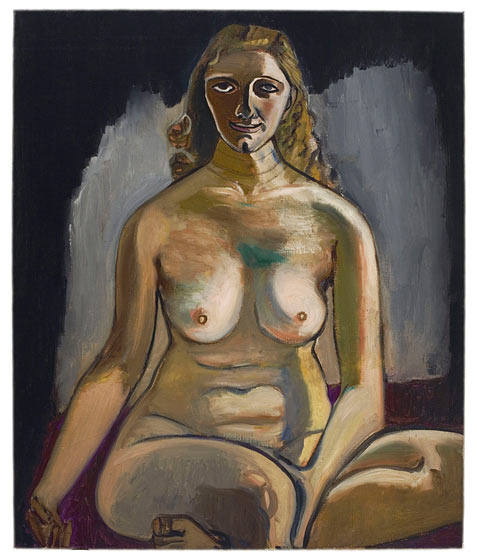
During the '30s when "it wasn't proper for a woman to be thinking about nudity,let alone displaying it in the artist's ruddy,forceful fashion"....uninhibited by convention,Alice painted daring, provocative female nudes...a subject that had been almost exclusively the domain of male artists ...and she kept figurative painting,and her concept of figuration, alive through decades when it was considered passe,even crude...


     Portrait of Rhoda Myers With Blue Hat

Alice Neel's portrait of Rhoda Myers Nude


                     Ethel Ashton, 1930, oil on canvas


                Nadya and Nona,1933

Winifred Mesmer

                         Ruth Nude


              Pregnant Julie and Algis,1967,oil on canvas

Annie Sprinkle


                        Pregnant Woman


         Margaret Evans Pregnant,1978


Mary D. Garrard, 1977


Elenka,1936,The Metropolitan Museum of Art,New York


Alice's 1972 portrait of art critic...John Perreault...who was the art critic for The Village Voce and then the SoHo News...this nude portrait of him is in the permanent collection of the Whitney Museum of American Art,New York...
see his Artopia...John Perreault's art diary http://www.artsjournal.com/artopia/2007/05/alice_neels_family_values.html

John Perreault is also an artist,as well as an art critic....this is a mural he painted in 2005 called Toothpaste Mural,toothpaste on canvas....really.


See The High Plains Alchemy of John Perreault

Also see interesting article in New York Times about the marriage of John Perreault and Jeff Weinstein in Provincetown,Massachusetts in 2008...


Alice's famously exaggerated 1933 portrait of the American eccentric,Joe Gould,also known as Professor Seagull...Gould pretended to be the author of the longest book ever written,an Oral History of the Contemporary World(or Oral History of Our Time)..in reality,the book never existed.Gould was a fraud... as his multiple genitalia suggests.As one reviewer said about his portrait,"it reveals how much she intuited his self-deception and accepted it - the picture is comic and benign".Neel was after truth...but on occasion,she was after irony and satire,too.

                             Young Woman


                                                              Hartley


                        Ballet Dancer

Portrait of Geoffrey Hendricks and Brian,1978


Ron Kajiwara

                                                   Sam and Hartley


Two Black Girls( Antonia and Carmen Encamacion),1959,oil on canvas

                                                       Jerry Sokol


Portrait of tranvestites,Rita Red and Jackie Curtis,two Superstars of Andy Warhol's factory,1970


Mrs. Paul Gardner and Son


                        Rita and Hubert

The Druid


       Victoria and the Cat,1980

 
Portrait of  artist Dana Gordon,1972


                                                            Hartley
Alice's 1966 portrait of her youngest son,Hartley,National Gallery of Art, Washington,D.C.....she painted this portrait when Hartley Neel was 25 and visiting her New York apartment during a holiday break from Tufts University... he was conflicted about studying medicine because he couldn't bear dissecting corpses...his gaze in this portrait indicates his thoughts are very far away...Alice said about this painting,"There is death in this painting"...you can see it in her use of grayish green to capture shadowy areas on his skin,but there is also a sensuousness which is frequently missing from her nudes,which are always frank and often disturbing,even grotesque.Although Neel was gifted at capturing likenesses,she avoided photographic verisimilitude,deliberately distorting features and using unnatural colors to capture her subjects' inner lives....


Alice's 1978 portrait of Virginia Miller...influential South Florida gallery owner and art exhibit curator...

Leading Feminist Art Historian...Linda Nochlin and Daisy...Nochlin
is best known for her influential essay, "Why Have There Been No Great Women Artists? Nochlin says,"its main thesis was an attack on the idea that genius is innate,something you are born with.And that this genius is specifically male".


Alice's 1973 portrait of the Soyer brothers,identical twins Moses and Raphael...the golden boys of '30s art and social realism in America...


Alice described herself as a "Captor of Souls"....


           Alice Neel, Fire Escape,1948

                      Ninth Avenue El, 1936

In the 1930s Neel lived in Greenwich Village and moved in mostly literary and left wing circles.In 1933 she enrolled in the Public Works Art Program,a project funded by the federal government intended to give out-of-work artists financial support in return for works of art.When it was discontinued,she signed up with the Works Progress Administration which required her to paint urban scenes.


"I love to paint people torn to shreds by the rat race in New York."...Alice Neel ...excerpt from www.artnewyork.org
                                                        http://youtu.be/juZWJOyjQ2M


"I don't look for anything...I just look"....Alice Neel...painting a young woman's portrait in her studio


"Whether I'm painting or not, I have an overweening interest in humanity. Even if I'm not working, I'm still analyzing people"


http://youtu.be/f6lnidx4C5c

http://youtu.be/ZG0iffwKWuA

http://youtu.be/MtAdYWmxLB4

A virtual tour of the Alice Neel Painted Truths exhibit at the Whitechapel Art Gallery,London,8 July-17 September,2010

http://youtu.be/L9tGKpyGdjY


For a gallery of Alice's work see http://artobserved.com/2009/06/go-see-new-york-alice-neel-selected-works-at-david-zwirner-and-nudes-of-the-1930s-at-zwirner-wirth-through-june-20-2009/
Alice Neel
For further reading:
             
1.Alice Neel: The Art of Not Sitting                  Pretty,Phoebe Hoban.

2.Pictures of People: Alice Neel's American Portrait Gallery,Pamela Allara,1998,Brandeis University Press,named one of 1998's Best art Books by the Boston Globe,this is  generously illustrated and vibrant chronicle of the life and work of Alice Neel,and shows how portraits from a career spanning the 1920s to the 1970s constitute a virtual gallery of American cultural history.Neel informed by left-wing politics and avant-garde modernism...infused portraiture with a new energy and relevance.